Who made the pictures.
The pictures on The Trail carry a caption and nothing else, so they can be seen whole. The credit is here: who made each of the 285 pictures, the films and the music, the licence each is used under, and where on the site it appears. Almost everything comes from Wikimedia Commons; a maker’s name opens the file’s own page, with its full record.
The front-page film
The film behind the count on the front page, cut from several stock clips. Neither licence asks for a credit; the makers are named anyway.
Christians at prayer
Film by A.J. Groomes, Askar Abayev, Luis Quintero, Anna Shvets and Mixkit, under the Pexels and Mixkit licences.
Artifacts
The picture is itself historical evidence: a manuscript, an inscription, an object or a work of art from the past.
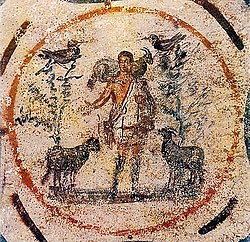
The Good Shepherd, Catacomb of Priscilla, Rome, third century.
Unknown artist · Public domain · Wikimedia Commons
Appears on: The martyrs and Decian persecution

The ‘Fractio Panis’: seven people at a table, one breaking bread. Catacomb of Priscilla, Rome, c. AD 200.
Unknown artist · Public domain · Wikimedia Commons
Appears on: The front page, Jesus leaves visible sacraments, Whose sins you forgive are forgiven, Did the early Christians believe in the Eucharist?, The Mass: AD 155 vs today and The River, immersive view

Icon of the Council of Nicaea, 325, with the Creed written out in Greek.
Unknown artist · Public domain · Wikimedia Commons
Appears on: Heresies force Christians to define things, The great councils, Who is Mary in Catholicism?, The Eastern-Western schism, The River: The age of councils and Council of Nicaea

The Chi Rho page of the Book of Kells, illuminated by monks around 800.
Unknown · Public domain · Wikimedia Commons
Appears on: The River: Monks and missions

The Crusaders enter Constantinople, 12 April 1204. Delacroix, 1840.
Eugène Delacroix · Public domain · Wikimedia Commons
Appears on: The Eastern-Western schism, The River: Christendom divided and Crusaders sack Constantinople

Martin Luther, painted by his friend Lucas Cranach in 1528.
Lucas Cranach the Elder · Public domain · Wikimedia Commons
Appears on: The River: The Reformation

The Council of Trent, painted by Pasquale Cati in 1588.
Pasquale Cati · Public domain · Wikimedia Commons
Appears on: The Catholic Reformation and Trent and Council of Trent

The Second Vatican Council in session, 1962–65.
Lothar Wolleh · CC BY-SA 3.0 · Wikimedia Commons
Appears on: The Eastern-Western schism, Second Vatican Council and The Church declares religious freedom

Papyrus P52, the oldest known fragment of the New Testament, c. AD 125–175.
Raxom · CC BY-SA 3.0 · Wikimedia Commons
Appears on: The front page, How we know and Scripture, Tradition and Magisterium

Codex Vaticanus, a fourth-century Greek Bible, open at Matthew 1–2.
Unknown artist · Public domain · Wikimedia Commons
Appears on: The family line to Christ, Scripture before there was a bound Bible and The River, immersive view

Justin presents his Apology to the emperor. Etching by Jacques Callot, 17th century.
Jacques Callot, Israël Henriet · Public domain · Wikimedia Commons
Appears on: The front page, The Mass: AD 155 vs today and Justin describes Sunday worship

Ignatius of Antioch on his way to the lions. Byzantine manuscript, c. 985.
Authors of Menologion of Basil II (circa 985 AC, Constantinople), Byzantine manu · Public domain · Wikimedia Commons
Appears on: What did Christianity look like in AD 100?, The Mass: AD 155 vs today, Ignatius of Antioch and Ignatius of Antioch

Pentecost: the Spirit descends on the apostles. Icon.
Unknown artist · Public domain · Wikimedia Commons
Appears on: Whose sins you forgive are forgiven, Pentecost: the Church goes public, The Mass: AD 155 vs today and Pentecost

Peter. Greek icon, 13th century.
13th century Greek icon painter · Public domain · Wikimedia Commons
Appears on: Did Jesus establish a visible Church? and Peter

Peter and Paul. Icon, Byzantine and Christian Museum, Athens.
George E. Koronaios · CC BY-SA 4.0 · Wikimedia Commons
Appears on: Paul


Polycarp. Byzantine manuscript, c. 985.
Authors of Menologion of Basil II (circa 985 AC, Constantino · Public domain · Wikimedia Commons
Appears on: Polycarp

Irenaeus. Stained glass, Lyon, 1901.
Lucien Bégule · Public domain · Wikimedia Commons
Appears on: Who is Mary in Catholicism? and Irenaeus

Perpetua and Felicity. Mosaic, Ravenna, 6th century.
Sailko · Public domain · Wikimedia Commons
Appears on: Perpetua and Felicity

Athanasius. Icon, Sozopol, 17th century.
Unknown artist · Public domain · Wikimedia Commons
Appears on: Athanasius


Augustine. Philippe de Champaigne, c. 1645.
Philippe de Champaigne · Public domain · Wikimedia Commons
Appears on: The Eastern-Western schism and Augustine


Gregory the Great. José de Ribera, 17th century.
Livioandronico2013 · CC BY-SA 4.0 · Wikimedia Commons
Appears on: Gregory the Great and Gregory the Great

Cyril and Methodius. Icon.
Unknown artist · Public domain · Wikimedia Commons
Appears on: Cyril and Methodius

Francis. Cimabue, Assisi, c. 1280, one of the earliest portraits.
Cimabue · Public domain · Wikimedia Commons
Appears on: Francis of Assisi

Thomas Aquinas. Carlo Crivelli, 1476.
Carlo Crivelli · Public domain · Wikimedia Commons
Appears on: Who is Mary in Catholicism? and Thomas Aquinas

Catherine of Siena. Drawing, 17th century.
Unknown artist · Public domain · Wikimedia Commons
Appears on: Catherine of Siena

Ignatius of Loyola. Engraving after Sánchez Coello.
After Alonso Sánchez Coello / Bartomeu Maura i Montaner · Public domain · Wikimedia Commons
Appears on: Ignatius of Loyola

Francis Xavier. Portrait, 17th century.
Unknown · Public domain · Wikimedia Commons
Appears on: Francis Xavier

Teresa of Ávila. Rubens, c. 1614.
Peter Paul Rubens · Public domain · Wikimedia Commons
Appears on: Teresa of Ávila

The twenty-six martyrs of Nagasaki, 1597. Painting, c. 1635.
Anonymous Japanese Master (painter) · Public domain · Wikimedia Commons
Appears on: Paul Miki and companions

Vincent de Paul. Portrait, 17th century.
anonymous · Public domain · Wikimedia Commons
Appears on: Vincent de Paul

Thérèse of Lisieux, photographed by her sister Céline, 1890s.
Céline Martin · Public domain · Wikimedia Commons
Appears on: Thérèse of Lisieux

Maximilian Kolbe, 1936.
Unknown artist · Public domain · Wikimedia Commons
Appears on: Maximilian Kolbe
Justin Martyr. Etching by Jacques Callot.
Jacques Callot, Israël Henriet · Public domain · Wikimedia Commons
Appears on: Justin Martyr

John. Greek icon, c. 1500, Monastery of St John the Theologian, Patmos.
Unknown Greek icon painter · Public domain · Wikimedia Commons
Appears on: John the Apostle

Mary Magdalene seated by the empty tomb. Icon by Konstantinos Tzanes, 17th century.
Konstantinos Tzanes · Public domain · Wikimedia Commons
Appears on: Mary Magdalene

Thomas. Russian icon, early 19th century.
Unknown Russian icon painter (early 19th cen.) · Public domain · Wikimedia Commons
Appears on: Thomas the Apostle

Cecilia, patron saint of music. Artemisia Gentileschi, 1640s.
Artemisia Gentileschi · Public domain · Wikimedia Commons
Appears on: Cecilia

A martyr saint, probably Lawrence. Cosimo Rosselli, about 1470, Walker Art Gallery, Liverpool.
Cosimo Rosselli · Public domain · Wikimedia Commons
Appears on: Lawrence

Cyprian of Carthage. Greek icon.
Unknown artist · Public domain · Wikimedia Commons
Appears on: Cyprian

Anthony the Great and his temptations. Cretan icon.
Unknown artist · Public domain · Wikimedia Commons
Appears on: Anthony of Egypt

John Chrysostom, framed by 40 scenes from his life. Icon by Semyon Spiridonov Kholmogorets, 1670s–80s, from a church in Yaroslavl.
Semyon Spiridonov · Public domain · Wikimedia Commons
Appears on: John Chrysostom

Jerome writing. Caravaggio, 1605–06, Galleria Borghese, Rome.
Caravaggio · Public domain · Wikimedia Commons
Appears on: Who is Mary in Catholicism? and Jerome

A page from a medieval manuscript of Bede's history of the English Church, reproduced in J. A. Giles's 1843 edition of his historical works.
Author Bede Translator J. A. Giles · Public domain · Wikimedia Commons
Appears on: Bede

Boniface fells the sacred oak. Christian Wilhelm Ernst Dietrich, 18th century, National Galleries of Scotland.
Christian Wilhelm Ernst Dietrich · Public domain · Wikimedia Commons
Appears on: Boniface

John of Damascus. Icon by Emmanouel Tzanes, 17th century.
Emmanouel Tzanes · Public domain · Wikimedia Commons
Appears on: The Eastern-Western schism and John Damascene

Anselm of Canterbury. Portrait of the late 16th century, later coloured.
Unknown artist · Public domain · Wikimedia Commons
Appears on: Anselm

The murder of Thomas Becket in Canterbury Cathedral. Manuscript painting of about 1200, the earliest known picture of it.
Unknown artist · Public domain · Wikimedia Commons
Appears on: Thomas Becket

Dominic kneeling at the foot of the cross. Fresco by Fra Angelico, 1441–42, San Marco, Florence.
Fra Angelico · Public domain · Wikimedia Commons
Appears on: Dominic

The Virgin Mary appears to Bonaventure. Leandro Bassano, Gallerie dell'Accademia, Venice.
Didier Descouens · Public domain · Wikimedia Commons
Appears on: Bonaventure

Louis IX, king of France. Lorenzo Peretti, 1818, Government Art Collection, UK.
Lorenzo Peretti · Public domain · Wikimedia Commons
Appears on: Louis IX

Elizabeth of Hungary. Sculpture by George Frampton, 1895, Victoria Art Gallery, Bath.
George Frampton · Public domain · Wikimedia Commons
Appears on: Elizabeth of Hungary

Bridget of Sweden. Maso da San Friano, 1540s, York Art Gallery.
Maso da San Friano · Public domain · Wikimedia Commons
Appears on: Bridget of Sweden

Joan of Arc in a painted initial letter, French National Archives. It looks medieval but was probably made in the late 19th century; no portrait of her made in her lifetime survives.
Unknown · Public domain · Wikimedia Commons
Appears on: Joan of Arc

Thomas More. Hans Holbein the Younger, 1527, Frick Collection, New York.
Hans Holbein the Younger · Public domain · Wikimedia Commons
Appears on: Thomas More

John Fisher. Portrait after Hans Holbein the Younger, 16th century, National Portrait Gallery, London.
anonymous · Public domain · Wikimedia Commons
Appears on: John Fisher

John of the Cross. Portrait of 1656, attributed to Francisco de Zurbarán.
Unknown artist · Public domain · Wikimedia Commons
Appears on: John of the Cross

Charles Borromeo pleads with God for the plague-stricken, held up by the Virgin Mary. Detail of Johann Michael Rottmayr's dome fresco, Karlskirche, Vienna, 1725–30.
Johann Michael Rottmayr Edited by Alberto Fernandez Fernande · Public domain · Wikimedia Commons
Appears on: Charles Borromeo

Francis de Sales, bishop of Geneva. Portrait at the Château de Bussy-Rabutin, France.
Benjamin Gavaudo · Public domain · Wikimedia Commons
Appears on: Francis de Sales

The mystic betrothal of Rose of Lima: the Christ Child takes her as his bride. Nicolás Correa, 1691.
Nicolás Correa · Public domain · Wikimedia Commons
Appears on: Rose of Lima
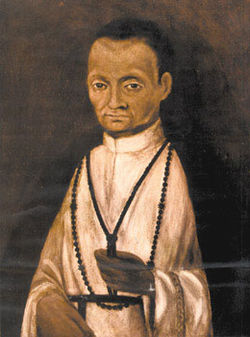
Martin de Porres. Painting by an unknown artist, 17th century, convent of Santa Rosa de las Monjas, Lima.
AnonymousUnknown author · Public domain · Wikimedia Commons
Appears on: Martin de Porres

Alphonsus Liguori. Painting kept by the Redemptorists, the order he founded.
Unknown · Public domain · Wikimedia Commons
Appears on: Alphonsus Liguori
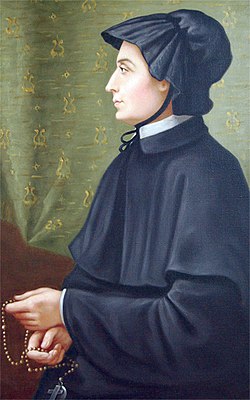
Elizabeth Ann Seton. Portrait by Amabilia Filicchi, copied from an engraving made of her in 1797.
Amabilia Filicchi · Public domain · Wikimedia Commons
Appears on: Elizabeth Ann Seton

Peter Chanel as a young priest. Engraving from Claude Nicolet's life of him, 1885.
Claude Nicolet · Public domain · Wikimedia Commons
Appears on: Peter Chanel

Bernadette Soubirous, photographed in the 1860s. Photographer unknown.
unknown · Public domain · Wikimedia Commons
Appears on: Bernadette Soubirous

Father Damien at Kalaupapa, Molokaʻi, photographed by William Brigham in 1889, weeks before he died.
William Brigham · Public domain · Wikimedia Commons
Appears on: Damien of Molokai

John Henry Newman as a cardinal. John Everett Millais, 1881, National Portrait Gallery, London.
John Everett Millais · Public domain · Wikimedia Commons
Appears on: John Henry Newman

Charles Lwanga and his companions, the martyrs of Uganda. Painting by Albert Wider.
Albert Wider · Copyrighted free use · Wikimedia Commons
Appears on: Charles Lwanga and companions

Edith Stein, photographed before she entered the Carmel of Cologne in 1933.
Unknown · Public domain · Wikimedia Commons
Appears on: Edith Stein

Gianna Beretta Molla with her first child, Pierluigi, in 1957.
Unknown artist · Public domain · Wikimedia Commons
Appears on: Gianna Beretta Molla

Pedro Calungsod on a Philippine postage stamp marking his canonisation on 21 October 2012.
Sy.Paul · Public domain · Wikimedia Commons
Appears on: Pedro Calungsod

Josemaría Escrivá on a Venezuelan postage stamp marking his beatification in 1992.
Post of Venezuela · Public domain · Wikimedia Commons
Appears on: Josemaría Escrivá

The Creation of Adam, Michelangelo, Sistine Chapel, c. 1511. A painting of the claim, not a record of a datable event.
Michelangelo · Public domain · Wikimedia Commons
Appears on: The River walk: Creation

The Fall and Expulsion from the Garden of Eden, Michelangelo, Sistine Chapel, 1509–10.
Michelangelo · Public domain · Wikimedia Commons
Appears on: The River walk: Adam and Eve

The Deluge, Johann König, oil on copper. An imagining: no archaeological trace of a worldwide flood has ever been found.
Johann König · Public domain · Wikimedia Commons
Appears on: The River walk: Noah and the flood
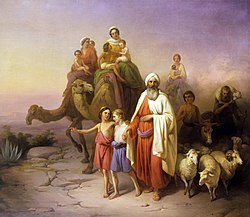
Abraham's Journey from Ur to Canaan, József Molnár, 1850. Nothing outside the Bible attests Abraham.
József Molnár · Public domain · Wikimedia Commons
Appears on: The River walk: The call of Abraham

The Israelites Leaving Egypt, David Roberts, 1829 — painted at the scale the text gives, which almost no historian accepts as literal.
David Roberts · Public domain · Wikimedia Commons
Appears on: The River walk: Moses and the Exodus

The Tel Dan Stele, ninth century BC. Its inscription carries the phrase most scholars read as 'the house of David'.
Gary Todd · CC0 · Wikimedia Commons
Appears on: The River walk: David, king of Israel

The building of the temple as Jean Fouquet painted it about 1470, for a French Josephus: a Gothic cathedral. Nothing of Solomon's temple has been recovered, and the platform where it stood cannot be excavated.
Jean Fouquet · Public domain · Wikimedia Commons
Appears on: The River walk: Solomon's temple

The Black Obelisk of Shalmaneser III, from Nimrud. The inscription names the kneeling figure as Jehu of the house of Omri — one of the Assyrian fixed points that make the ninth century checkable.
Osama Shukir Muhammed Amin FRCP(Glasg) · CC BY-SA 4.0 · Wikimedia Commons
Appears on: The River walk: The kingdom divides

The deportation of Lachish, carved for Sennacherib's palace at Nineveh, 700–692 BC. His campaign against Judah is attested from both sides.
Osama Shukir Muhammed Amin FRCP(Glasg) · CC BY-SA 4.0 · Wikimedia Commons
Appears on: The River walk: Assyria and the prophets

The Flight of the Prisoners, James Tissot, c. 1896–1902. That there was a deportation is certain; how many went is debated.
James Tissot · Public domain · Wikimedia Commons
Appears on: The River walk: Jerusalem falls and the exile begins

The Cyrus Cylinder. It records Cyrus restoring sanctuaries and sending displaced peoples home — but it never mentions Judah, Jerusalem or the Jews.
Mohammad Nemat Zadeh · CC0 · Wikimedia Commons
Appears on: The River walk: The return from exile

Judas Maccabeus Pursues Timotheus, Gustave Doré, 1866. The books that carry this story are Scripture for Catholics and Orthodox, and not for the Reformers or the Jewish canon.
Gustave Doré · Public domain · Wikimedia Commons
Appears on: The River walk: The Maccabean revolt

Adoration of the Shepherds, Gerard van Honthorst, 1622. Neither the day nor the year of the birth is known.
Gerard van Honthorst · Public domain · Wikimedia Commons
Appears on: The River walk: The birth of Christ

The Baptism of Christ, Nicolas Poussin, 1641–42, National Gallery of Art, Washington.
Nicolas Poussin · CC0 · Wikimedia Commons
Appears on: The River walk: The public ministry begins

Christ Handing the Keys to Saint Peter, Perugino, 1481–82 — one reading of the passage, painted on a papal wall in the Sistine Chapel.
Pietro Perugino · Public domain · Wikimedia Commons
Appears on: The River walk: You are Peter

The Last Supper, Leonardo da Vinci, 1495–98, Santa Maria delle Grazie, Milan.
Leonardo da Vinci · Public domain · Wikimedia Commons
Appears on: The River walk: The Last Supper

Crucifixion, Andrea Mantegna, from the San Zeno altarpiece, c. 1457–59; Louvre.
Andrea Mantegna · Public domain · Wikimedia Commons
Appears on: The River walk: The crucifixion

The Anastasis, Chora church, Constantinople. The Eastern image of the resurrection: Christ hauling Adam and Eve out of their graves by the wrist.
Unknown artist · Public domain · Wikimedia Commons
Appears on: The River walk: Christ is risen

The Ascension, Giotto, Scrovegni Chapel, Padua, c. 1303–05.
Giotto · Public domain · Wikimedia Commons
Appears on: The River walk: The ascension and the commission

The Lanciano relics as displayed in the sanctuary. A photograph shows what is venerated, not what it is.
Junior · Public domain · Wikimedia Commons
Appears on: Sign: Lanciano

The image on the tilma, Basilica of Guadalupe, Mexico City.
God (1531 presented by Juan Diego) · Public domain · Wikimedia Commons
Appears on: Sign: Guadalupe

The crowd at Fátima on 13 October 1917, photographed by Judah Ruah for O Século. It shows people looking up. It does not show what they saw.
Judah Bento Ruah · Public domain · Wikimedia Commons
Appears on: Sign: Fátima

The face on the Shroud as it appears in Secondo Pia’s photographic negative of 28 May 1898. The negative is what made the image legible.
Secundo Pia · Public domain · Wikimedia Commons
Appears on: Sign: The Shroud of Turin

Jan Hus in the fire at Constance, painted seventy years later for Diebold Schilling’s Spiezer Chronik (1485).
Diebold Schilling the Elder · Public domain · Wikimedia Commons
Appears on: Jan Hus burned at Constance

The Millerite chart of the visions of Daniel and John, published in Boston by Joshua V. Himes, which works the prophecies out to the year 1843; this copy is a later reproduction.
Joshua V. Himes (publisher); E. W. Thayer & Co., Boston (lithographers) · Public domain · Wikimedia Commons
Appears on: The Great Disappointment

A Christian Mission notice of 1878 calling the mission 'a Volunteer Army', the phrase Booth rewrote as Salvation Army.
The Christian Mission (unknown printer), 1878 · Public domain · Wikimedia Commons
Appears on: Booth's mission becomes The Salvation Army

A column of the Great Isaiah Scroll, found at Qumran in 1947 and copied in the second century BC.
Ardon Bar Hama (photograph) · Public domain · Wikimedia Commons
Appears on: The River, immersive view

Christ Pantocrator, apse of Monreale Cathedral, Sicily, 1180s: a Latin cathedral decorated in the Byzantine manner.
José Luiz · CC BY-SA 4.0 · Wikimedia Commons
Appears on: The River, immersive view

Ignatius the God-bearer on a Byzantine tile, 10th century. Walters Art Museum, Baltimore.
Unknown Byzantine artist · Public domain · Wikimedia Commons
Appears on: The River, immersive view

Gregory the Great. Francisco Goya, 1790s.
Francisco Goya · Public domain · Wikimedia Commons
Appears on: The River, immersive view

Justin the Philosopher. Fresco by Theophanes the Cretan, 1545–46.
Theophanes the Cretan · Public domain · Wikimedia Commons
Appears on: The River, immersive view

The Crucifixion of Saint Peter, Caravaggio, 1600. Eusebius records that Peter was crucified under Nero.
Caravaggio · Public domain · Wikimedia Commons
Appears on: Peter → Bishop of Rome → Pope

Gregory the Great with the dove of the Holy Spirit at his ear. Miniature from a manuscript of his letters, Trier, after 983.
Master of the Registrum Gregorii · Public domain · Wikimedia Commons
Appears on: Peter → Bishop of Rome → Pope

Boniface VIII in a fresco fragment attributed to Giotto, painted about 1300 and now in St John Lateran, Rome.
Giotto · Public domain · Wikimedia Commons
Appears on: Peter → Bishop of Rome → Pope

The Shroud on display in Turin cathedral during the exposition of 2010. The two faint figures, head to head, are the front and back of one man. The pale shapes in rows are damage from the fire of 1532.
Fabio Poggi · CC BY 3.0 · Wikimedia Commons
Appears on: The Shroud of Turin

The Image Not Made by Hands, an icon of about 1100 in the Tretyakov Gallery, Moscow. Eastern tradition remembers the cloth of Edessa as bearing Christ's face, not a full body.
Anonymous icon painter (Tretyakov Gallery, Moscow) · Public domain · Wikimedia Commons
Appears on: The Shroud of Turin

'Il verissimo ritratto', an engraving printed in Turin in 1608. A row of bishops holds up the cloth, drawn with its double figure and the marks left by the fire of 1532 along its folds.
Unknown engraver, printed in Turin for Giovanni Antonio Silva · Public domain · Wikimedia Commons
Appears on: The Shroud of Turin

Secondo Pia's photograph of 1898. Left, his glass negative, on which the face appears as a natural-looking positive. Right, the developed print, showing the face as it looks on the cloth.
Secondo Pia, 1898; image editing by Rudolf Berwanger · CC BY-SA 4.0 · Wikimedia Commons
Appears on: The Shroud of Turin

John XXIII at the opening of the Second Vatican Council, 11 October 1962. Photograph by Lothar Wolleh.
Lothar Wolleh · Public domain · Wikimedia Commons
Appears on: Vatican II

The Oecumenical Council of the Vatican, convened December 8th 1869: a hand-coloured lithograph printed in 1870, now in the Library of Congress.
Unknown lithographer (Library of Congress, Popular Graphic Arts collection) · Public domain · Wikimedia Commons
Appears on: Vatican I

The council in session in St Peter's, engraved by Karl Benzinger for a book on Pius IX, 1873.
Karl Benzinger · Public domain · Wikimedia Commons
Appears on: Vatican I

Pius IX, photographed by Adolphe Braun on 13 May 1875 for his eighty-third birthday.
Adolphe Braun · Public domain · Wikimedia Commons
Appears on: Vatican I

Vinzenz Gasser, bishop of Brixen, in a lithograph by Josef Kriehuber, 1856.
Josef Kriehuber · Public domain · Wikimedia Commons
Appears on: Vatican I

The breach beside the Porta Pia, photographed in 1870. The printed caption reads 'Breccia a Porta Pia, eseguita dalle truppe italiane il 20 settembre 1870': breach at Porta Pia, made by the Italian troops on 20 September 1870.
Studio of L. Tuminello, Rome (attributed on Commons to Gioacchino Altobelli) · Public domain · Wikimedia Commons
Appears on: Vatican I

Ignaz von Döllinger, painted by Franz von Lenbach in 1874, three years after his excommunication.
Franz von Lenbach · Public domain · Wikimedia Commons
Appears on: Vatican I

Lúcia dos Santos, Francisco Marto and Jacinta Marto, the three children of Fátima, in 1917.
Attributed to Joshua Benoliel · Public domain · Wikimedia Commons
Appears on: Marian apparitions

Juan de Zumárraga, first bishop of Mexico and the bishop in the Guadalupe story. Portrait by an unknown artist.
Unknown artist · Public domain · Wikimedia Commons
Appears on: Marian apparitions

Bernadette Soubirous in 1863, five years after the apparitions. Photograph by Billard-Perrin.
Auguste Billard-Perrin · Public domain · Wikimedia Commons
Appears on: Marian apparitions

The grotto of Massabielle about 1860, before the shrine buildings of 1864. Lithograph by Charles Mercereau.
Charles Mercereau · Public domain · Wikimedia Commons
Appears on: Marian apparitions

Ilustração Portuguesa, 29 October 1917: Avelino de Almeida's second report, with photographs of the crowd. They show people looking up, not what they saw.
Ilustração Portuguesa (O Século), Lisbon · Public domain · Wikimedia Commons
Appears on: Marian apparitions

The reliquary made for the Bolsena corporal by Ugolino di Vieri of Siena, 1337-39. Its enamel scenes are the oldest surviving account of the miracle.
Abxbay · CC0 · Wikimedia Commons
Appears on: Eucharistic miracles

Thomas Aquinas with an open book, fresco by Fra Angelico, convent of San Marco, Florence, about 1442.
Fra Angelico · Public domain · Wikimedia Commons
Appears on: Eucharistic miracles

Laurent Imbert as bishop. Portrait by an unknown artist.
Unknown artist · Public domain · Wikimedia Commons
Appears on: From Pentecost to your parish

The plaque over Imbert's relics in the Cathedral of the Good Shepherd. It calls him probably the first priest to visit the island's Catholics, in December 1821.
Sparkiejev · Public domain · Wikimedia Commons
Appears on: From Pentecost to your parish

Scipione Rebiba, the earliest bishop in the recorded line of most Latin Catholic bishops. Portrait by an unknown sixteenth-century artist.
Unknown artist · Public domain · Wikimedia Commons
Appears on: From Pentecost to your parish

The theatre built inside St Peter's for the canonisation of Gaetano Thiene and Francis Borgia in 1671. Etching by Giovanni Battista Falda.
Giovanni Battista Falda; The Metropolitan Museum of Art · CC0 · Wikimedia Commons
Appears on: How does someone become a canonised saint?

Cardinal Prospero Lambertini, later Pope Benedict XIV, at his books. Portrait by Giuseppe Maria Crespi.
Giuseppe Maria Crespi · Public domain · Wikimedia Commons
Appears on: How does someone become a canonised saint?

The banner of Thérèse of Lisieux carried into St Peter's on the day of her canonisation, 17 May 1925.
Unknown photographer · Public domain · Wikimedia Commons
Appears on: How does someone become a canonised saint?

Padre Pio in 1919, showing the marks on his hands that the Holy Office later investigated. Photograph by Placido Bux.
Placido Bux · Public domain · Wikimedia Commons
Appears on: How does someone become a canonised saint?

Surviving fragment of the gravestone of Abercius, bishop of Hieropolis, late second or early third century. Vatican Museums.
Fabrizio Garrisi · CC BY-SA 4.0 · Wikimedia Commons
Appears on: Relics and other Christian artifacts

Piero della Francesca, Finding and Recognition of the True Cross, San Francesco, Arezzo, between 1452 and 1466. It paints the later legend, in which a miracle picks out the true cross.
Piero della Francesca (photo: Web Gallery of Art) · Public domain · Wikimedia Commons
Appears on: Relics and other Christian artifacts

Reliquary made for the Crown of Thorns in Paris in 1862 by Placide Poussielgue-Rusand after Viollet-le-Duc, shown empty at the Louvre in January 2024.
Marie-Lan Nguyen · CC BY 4.0 · Wikimedia Commons
Appears on: Relics and other Christian artifacts

The procession of martyrs, a sixth-century mosaic in the nave of Sant’Apollinare Nuovo, Ravenna.
Sharon Mollerus · CC BY 2.0 · Wikimedia Commons
Appears on: The saints timeline
The Crucifixion of Saint Peter, Caravaggio, about 1600. The story that Peter was crucified head downwards is first told around AD 200.
Caravaggio · Public domain · Wikimedia Commons
Appears on: The saints timeline

Joan of Arc, sketched in 1429, while she was alive, in the margin of the register of the Parliament of Paris by its clerk, Clément de Fauquembergue. French National Archives.
Clément de Fauquembergue · Public domain · Wikimedia Commons
Appears on: The saints timeline

Jean-Paul Laurens, Pope Formosus and Stephen VI (1870). A nineteenth-century imagining of the synod of January 897, at which Stephen VI put his predecessor's corpse on trial.
Jean-Paul Laurens (Musée des Beaux-Arts, Nantes) · Public domain · Wikimedia Commons
Appears on: Bad popes, antipopes and scandals

The seventh-century apse mosaic of Sant'Agnese fuori le mura, Rome. Pope Honorius I, who rebuilt the church, stands on the left holding its model.
José Luiz · CC BY-SA 4.0 · Wikimedia Commons
Appears on: Bad popes, antipopes and scandals

Cristoforo Roncalli, Saint Catherine persuades Gregory XI to return from Avignon to Rome (1582), in the house of Saint Catherine, Siena. The inscription credits the return to Catherine's urging.
Photograph by Sailko · CC BY 3.0 · Wikimedia Commons
Appears on: Bad popes, antipopes and scandals

The election of Martin V at the Council of Constance, 11 November 1417, from the chronicle of Ulrich Richental (copy of about 1464).
Chronicle of Ulrich Richental · Public domain · Wikimedia Commons
Appears on: Bad popes, antipopes and scandals

Alexander VI kneeling, a detail of Pinturicchio's Resurrection fresco in the Borgia Apartments of the Vatican (1492-1494), painted during his pontificate.
Pinturicchio · Public domain · Wikimedia Commons
Appears on: Bad popes, antipopes and scandals

Adrian VI, 'of Utrecht', in an engraving from Onofrio Panvinio's portraits of the popes (1568).
Unknown engraver, in Onofrio Panvinio (1568) · Public domain · Wikimedia Commons
Appears on: Bad popes, antipopes and scandals

Ambrose bars Theodosius from Milan's cathedral, as Anthony van Dyck imagined it around 1620. The scene at the church door is a later legend; Ambrose's own letter shows he wrote to the emperor privately.
Anthony van Dyck · Public domain · Wikimedia Commons
Appears on: Christianity becomes the empire's religion

The Visigoths sack Rome in 410, as Joseph-Noël Sylvestre imagined it in 1890.
Joseph-Noël Sylvestre · Public domain · Wikimedia Commons
Appears on: Rome falls in the West

The victory over the Saracen fleet at Ostia in 849, as Raphael's workshop imagined it in 1514–15 for a room in the Vatican. Leo IV, seated on the left, is given the face of Leo X, the pope who paid for it.
Raphael and workshop · Public domain · Wikimedia Commons
Appears on: Popes fighting to survive

Urban II at the Council of Clermont in 1095, as the illuminator Jean Colombe imagined it around 1474, in Sébastien Mamerot's Passages d'Outremer (BnF Fr. 5594).
Jean Colombe · Public domain · Wikimedia Commons
Appears on: The First Crusade

Priests who refused the oath are killed at the Carmes convent in Paris in the September massacres of 1792, engraved that same week for the Paris paper Révolutions de Paris.
Unknown engraver, Révolutions de Paris no. 165 · Public domain · Wikimedia Commons
Appears on: The Revolution turns on the Church

Clement of Rome. Mosaic in St Sophia's Cathedral, Kyiv, 11th century.
Unknown artist · Public domain · Wikimedia Commons
Appears on: Clement of Rome

Leo the Great. Francisco Herrera the Younger, 17th century, Prado Museum, Madrid.
Francisco Herrera the Younger · Public domain · Wikimedia Commons
Appears on: Leo the Great

Columba. Stained glass by Karl Parsons, 1913, made for St Michael's church, Sulhamstead, and now in the Stained Glass Museum, Ely.
Karl Parsons (window); The wub (photograph) · CC0 · Wikimedia Commons
Appears on: Columba

John Bosco in Turin, 1880. Photograph attributed to Carlo Felice Deasti.
Carlo Felice Deasti (attributed) · Public domain · Wikimedia Commons
Appears on: John Bosco

Pius X. Photograph by Ernest Walter Histed, taken before 1914.
Ernest Walter Histed · Public domain · Wikimedia Commons
Appears on: Pius X

Faustina Kowalska in 1931, the year of the vision behind the Divine Mercy image.
Unknown photographer · Public domain · Wikimedia Commons
Appears on: Faustina Kowalska

Josephine Bakhita in the habit of the Canossian Sisters. Photograph, early 20th century.
Unknown photographer · Public domain · Wikimedia Commons
Appears on: Josephine Bakhita

Padre Pio in later life, probably in the late 1950s. Photographer unknown.
Unknown photographer · Public domain · Wikimedia Commons
Appears on: Padre Pio
Photographs and paintings
Atmosphere only: a place as it looks today, or a later picture of an earlier scene. They set the scene; they are not evidence.

The Appian Way, the road Paul walked into Rome. Painting by John Linton Chapman, 1867.
John Linton Chapman · Public domain · Wikimedia Commons

Jerusalem from above the Mount of Olives.
Godot13 · CC BY-SA 4.0 · Wikimedia Commons
Appears on: The covenant trail, Jesus of Nazareth and The River: Israel: kingdom, exile, waiting

The Crypt of the Popes in the Catacomb of Callixtus, Rome, where third-century bishops of Rome were buried, among them Fabian, killed under Decius in 250.
Dnalor 01 · CC BY-SA 3.0 · Wikimedia Commons
Appears on: Rome vs the Christians and The River: The age of persecution

Hagia Sophia, Constantinople, in section: Wilhelm Salzenberg's reconstruction of the Byzantine church, published in 1854. The papal legates laid their bull on its altar in 1054.
Wilhelm Salzenberg and Carl Wilhelm Kortüm · Public domain · Wikimedia Commons
Appears on: The River, The Eastern-Western schism and Mutual excommunications

Chartres Cathedral, built 1194–1220.
Stephen Taber · CC BY-SA 4.0 · Wikimedia Commons
Appears on: The River: Crisis and calls for reform

Saint Peter’s Basilica, Rome.
Jebulon · CC0 · Wikimedia Commons
Appears on: The River: Revolutions and missions and The Day of Pardon

Easter Sunday Mass, Baliuag, Philippines, 2021.
JFVelasquez Floro · CC0 · Wikimedia Commons
Appears on: The Mass: AD 155 vs today, The River: A global Church and Your parish, Saturday evening

A parish confessional, Auckland.
Bjankuloski06 · CC BY 4.0 · Wikimedia Commons
Appears on: Whose sins you forgive are forgiven

One river, many channels: the Lena delta from orbit.
none (Landsat) · Public domain · Wikimedia Commons
Appears on: The front page, The River, Creation: what went wrong? and The River, immersive view

Monte Cassino, founded by Benedict in 529, rebuilt after 1944.
ThePhotografer · CC BY-SA 4.0 · Wikimedia Commons
Appears on: Benedict founds Monte Cassino

Hands laid on a new bishop, 2014. The same gesture Clement describes in AD 96.
Rei Momo · Public domain · Wikimedia Commons
Appears on: Whose sins you forgive are forgiven and Apostolic succession

Lorenzo Ruiz. Statue, Binondo Church, Manila.
Ralff Nestor Nacor · CC BY-SA 4.0 · Wikimedia Commons
Appears on: Lorenzo Ruiz

Andrew Kim Taegon, the first Korean-born Catholic priest. Bronze bust in South Korea.
pcamp · CC BY 2.0 · Wikimedia Commons
Appears on: Andrew Kim Taegon

Mother Teresa, Bonn, 1986.
Túrelio · CC BY-SA 2.0 de · Wikimedia Commons
Appears on: Teresa of Calcutta

John Paul II, Katowice, 1983.
Bernard Gotfryd · Public domain · Wikimedia Commons
Appears on: John Paul II


Basil the Great. Icon on the iconostasis, the icon screen, of the wooden church at Uličské Krivé, Slovakia.
Misko3 · CC BY-SA 4.0 · Wikimedia Commons
Appears on: Basil the Great

Ambrose. Mosaic in Westminster Cathedral, London, 1912–16.
Meduer · CC BY-SA 4.0 · Wikimedia Commons
Appears on: Ambrose

Martin of Tours on horseback. Painting in his parish church at Bocaue, Bulacan, in the Philippines.
Ralff Nestor Nacor · CC BY-SA 4.0 · Wikimedia Commons
Appears on: Martin of Tours

Bernard of Clairvaux. Workshop of Filippo Lippi, about 1447, Metropolitan Museum of Art, New York.
Workshop of Filippo Lippi · CC0 · Wikimedia Commons
Appears on: Who is Mary in Catholicism? and Bernard of Clairvaux

Hildegard of Bingen. Detail from the Salem manuscript of her book of visions, Scivias, about 1200.
Beloved female saints · CC0 · Wikimedia Commons
Appears on: Hildegard of Bingen

Clare of Assisi with lilies and a book. Tiberio d'Assisi, early 16th century.
Beloved female saints · CC0 · Wikimedia Commons
Appears on: Clare of Assisi

Anthony of Padua with the Christ Child. Oil painting, possibly by Antonio Paglia, early 18th century.
Possibly Antonio Paglia (1680 – 1747) · CC BY-SA 4.0 · Wikimedia Commons
Appears on: Anthony of Padua

Philip Neri at the altar. Giandomenico Tiepolo, in the Oratory of the Crucifix at the church of San Polo, Venice.
Didier Descouens · CC BY-SA 4.0 · Wikimedia Commons
Appears on: Philip Neri

Kateri Tekakwitha. Statue on the front of the Basilica of Sainte-Anne-de-Beaupré, near Quebec City.
LovesMacs · CC BY-SA 3.0 · Wikimedia Commons
Appears on: Kateri Tekakwitha

Andrew Dũng-Lạc. Statue at Sở Kiện church, Hà Nam province, Vietnam.
Hoangvantoanajc · CC BY-SA 4.0 · Wikimedia Commons
Appears on: Andrew Dung-Lac

Óscar Romero. Bronze bust in St Martin-in-the-Fields, London, with flowers left beneath it.
Basher Eyre · CC BY-SA 2.0 · Wikimedia Commons
Appears on: Oscar Romero

Devasahayam Pillai in chains. Statue at St Francis Xavier Cathedral, Kottar, Nagercoil, India.
Kumbalam · CC BY-SA 3.0 · Wikimedia Commons
Appears on: Devasahayam Pillai

Titus Brandsma. Statue by Gerard Mathot on the Pieter Bondamplein, Nijmegen, the Netherlands.
FakirNL · CC BY-SA 4.0 · Wikimedia Commons
Appears on: Titus Brandsma

Jebel Musa in the southern Sinai, identified as the mountain of the covenant by fourth-century monastic tradition rather than by evidence.
Tamerlan at Polish Wikipedia · Public domain · Wikimedia Commons
Appears on: The River walk: The covenant at Sinai

Raphael’s Mass at Bolsena, Vatican, 1512–14: the story as Rome painted it 250 years after the date it gives.
Raphael · Public domain · Wikimedia Commons
Appears on: Sign: Bolsena and Orvieto

The church of the Santíssimo Milagre, Santarém, where the relic is kept.
GualdimG · CC BY-SA 4.0 · Wikimedia Commons
Appears on: Sign: Santarém

The chapel of the Sacre Particole in San Francesco, Siena, where the hosts of 1730 are kept.
Nikozw · CC0 · Wikimedia Commons
Appears on: Sign: The Sacred Particles of Siena

The chapel of the rue du Bac, Paris, where Catherine Labouré reported the apparitions of 1830.
Guilhem Vellut from Paris, France · CC BY 2.0 · Wikimedia Commons
Appears on: Sign: Rue du Bac

The grotto of Massabielle, Lourdes.
Mentnafunangann · CC BY-SA 4.0 · Wikimedia Commons
Appears on: Sign: Lourdes

The Apparition Chapel at Knock, County Mayo, on the gable wall of the parish church.
KnockShrine · CC BY-SA 4.0 · Wikimedia Commons
Appears on: Sign: Knock

The chapel of the Virgin of the Poor at Banneux, one of the two Belgian sites of 1932–33.
Unknown · Public domain · Wikimedia Commons
Appears on: Sign: Beauraing and Banneux

The statue at Akita, Japan, reported to have wept between 1975 and 1981.
SICDAMNOME · CC BY-SA 4.0 · Wikimedia Commons
Appears on: Sign: Akita and Kibeho

The parish of Santa María, Avenida La Plata, Buenos Aires, where the hosts of 1992–96 were kept.
Nicolasrnphoto · CC BY-SA 4.0 · Wikimedia Commons
Appears on: Sign: Buenos Aires

The parish church of Tixtla, Guerrero, usually named as the place of the 2006 event.
Catedrales e Iglesias/Cathedrals and Churches from Puebla de los Ángeles, Mexico · CC BY 2.0 · Wikimedia Commons
Appears on: Sign: Tixtla

The church of St Anthony, Sokółka, now the Sanctuary of the Blessed Sacrament.
Zala · CC BY-SA 4.0 · Wikimedia Commons
Appears on: Sign: Sokółka

The church of St Hyacinth (św. Jacek), Legnica, where the host of 2013 is kept.
Emilia Ernst (changes by Rabanus Flavus) · CC BY-SA 4.0 · Wikimedia Commons
Appears on: Sign: Legnica

The Miracle of Amsterdam painted by Jacob Cornelisz van Oostsanen in 1518, 173 years after the event.
Jacob Cornelisz van Oostsanen · Public domain · Wikimedia Commons
Appears on: Sign: The Miracle of Amsterdam

The abbey church of Faverney, where the host of 1608 is kept.
Jean de l'Auxois · CC BY-SA 4.0 · Wikimedia Commons
Appears on: Sign: Faverney

The Sanctuary of the Precious Blood, Ludbreg, Croatia.
Miroslav.vajdic · CC BY 4.0 · Wikimedia Commons
Appears on: Sign: Ludbreg

The cathedral of San Paolo, Alatri, where the reliquary of 1228 is kept.
The original uploader was Fabiosbaraglia at Italian Wikipedia. · Public domain · Wikimedia Commons
Appears on: Sign: Alatri

The tempietto of 1594 in Santa Maria in Vado, Ferrara, built around the vault said to have been stained in 1171.
Zairon · CC BY-SA 4.0 · Wikimedia Commons
Appears on: Sign: Ferrara

The sanctuary at Betania, Venezuela.
Warairarepano&Guaicaipuro · CC0 · Wikimedia Commons
Appears on: Sign: Betania

The chapel of the Pénitents Gris, Avignon, where the brothers still gather every 30 November.
Marianne Casamance · CC BY-SA 4.0 · Wikimedia Commons
Appears on: Sign: Avignon

The statues on the mountain at La Salette, recording the first moments of the apparition as the children described it.
FredSeiller · CC0 · Wikimedia Commons
Appears on: Sign: La Salette

The Barbedette barn at Pontmain, where Eugène and Joseph were working on the evening of 17 January 1871.
Ikmo-ned · CC BY-SA 3.0 · Wikimedia Commons
Appears on: Sign: Pontmain

The Apparition Chapel at Champion, Wisconsin.
Michael Barera · CC BY-SA 4.0 · Wikimedia Commons
Appears on: Sign: Our Lady of Champion (Good Help)

The basilica at Le Laus, Hautes-Alpes.
AntonyB · CC BY-SA 3.0 · Wikimedia Commons
Appears on: Sign: Notre-Dame du Laus

The sanctuary at Gietrzwałd, Warmia.
Krzysztof Popławski · CC BY-SA 4.0 · Wikimedia Commons
Appears on: Sign: Gietrzwałd

The Coptic church of St Mary at Zeitoun, Cairo, over whose domes the apparitions of 1968 were reported.
F50R2J · CC BY-SA 4.0 · Wikimedia Commons
Appears on: Sign: Zeitoun

The parish church of St James, Medjugorje.
Neoneo13 · Public domain · Wikimedia Commons
Appears on: Sign: Medjugorje

Jerusalem before the Romans destroyed it in AD 70, in the Holyland Model at the Israel Museum: the city where the apostles and elders met over the Gentile question.
Berthold Werner · Public domain · Wikimedia Commons
Appears on: Council of Jerusalem

Nero’s Torches, Henryk Siemiradzki, 1876: a nineteenth-century painter’s picture of Tacitus’s account.
Henryk Siemiradzki · Public domain · Wikimedia Commons
Appears on: Nero's persecution

The apse mosaic of San Clemente, Rome, the church that bears Clement’s name.
Rita1234 · CC BY-SA 3.0 · Wikimedia Commons
Appears on: Clement of Rome writes to Corinth

Pliny the Younger on the façade of Como cathedral, his home town.
Howwi · CC BY-SA 3.0 · Wikimedia Commons
Appears on: Pliny reports to Trajan

The colossal head of Constantine, Capitoline Museums, Rome.
D. Benjamin Miller · Public domain · Wikimedia Commons
Appears on: Edict of Milan

The council of 381 as painted about 880 in the Paris Gregory manuscript.
AnonymousUnknown author · Public domain · Wikimedia Commons
Appears on: Council of Constantinople

The Church of Mary at Ephesus, where the council of 431 met.
Marmaracalypso · CC BY-SA 4.0 · Wikimedia Commons
Appears on: Council of Ephesus

The Council of Chalcedon as painted by Vasily Surikov in 1876.
Vasily Surikov · Public domain · Wikimedia Commons
Appears on: Council of Chalcedon

The Triumph of Orthodoxy, an icon of about 1400 celebrating the return of the images the council of 787 had defended.
anonymous · Public domain · Wikimedia Commons
Appears on: Second Council of Nicaea

Innocent III, painted at Subiaco in his own lifetime.
Carlo Raso · Public domain · Wikimedia Commons
Appears on: Fourth Lateran Council

Aquinas dying on the road to Lyon, 1274, from a seventeenth-century engraved life.
Panderen, Egbert van (c1580-after 1617) · CC BY 4.0 · Wikimedia Commons
Appears on: Second Council of Lyon

The Palais des Papes, Avignon, seat of one of the rival lines during the Western Schism.
Acediscovery · CC BY 4.0 · Wikimedia Commons
Appears on: The Western Schism

Pisanello’s medal of the emperor John VIII, struck while the Greeks were in Italy for the council.
Pisanello · CC0 · Wikimedia Commons
Appears on: Council of Florence

The 1858 bronze doors of the Castle Church, Wittenberg, cast with the text of the theses.
Avi1111 dr. avishai teicher · CC BY-SA 4.0 · Wikimedia Commons
Appears on: Luther's Ninety-five Theses

The drowning of Felix Manz at Zurich, 5 January 1527, from Heinrich Thomann’s chronicle.
Heinrich Thomann · Public domain · Wikimedia Commons
Appears on: Anabaptists killed by both sides

The burning of Latimer and Ridley at Oxford, 1555, as Foxe’s Book of Martyrs printed it.
Unknown · Public domain · Wikimedia Commons
Appears on: Mary I burns the reformers

Pius V, painted by El Greco.
El Greco · Public domain · Wikimedia Commons
Appears on: The pope deposes Elizabeth

Edmund Campion, executed at Tyburn on 1 December 1581.
Campion, Edmund, saint (1540-1581) (depicted) · Public domain · Wikimedia Commons
Appears on: The penal laws and the priests

The oath of ratification at Münster, 15 May 1648, painted by Gerard ter Borch, who was there.
Gerard ter Borch · Public domain · Wikimedia Commons
Appears on: The wars of religion end in exhaustion

The First Vatican Council in session in the north transept of St Peter’s, 1870.
ignote · Public domain · Wikimedia Commons
Appears on: First Vatican Council

Titian’s Assumption in the Frari, Venice, painted 1516–18, four centuries before the definition.
Titian · Public domain · Wikimedia Commons
Appears on: The Assumption defined

Athenagoras and Paul VI in Rome, October 1967, two years after the excommunications were lifted.
Unknown photographer · Public domain · Wikimedia Commons
Appears on: Excommunications of 1054 lifted

St Anna, Augsburg, the Lutheran church where the Joint Declaration was signed on 31 October 1999.
Ansichtensammlung "Augusta Vindelicorum" von Simon Grimm, 1704 · CC BY-SA 4.0 · Wikimedia Commons
Appears on: Joint Declaration on Justification

The basilica of Corpus Christi, Kazimierz, Kraków, founded by Casimir III in 1345.
Jorge Láscar · CC BY 2.0 · Wikimedia Commons
Appears on: Sign: Kraków

The parish church of St Oswald, Seefeld in Tirol, where the host of 1384 is kept.
Strubbl · CC BY-SA 4.0 · Wikimedia Commons
Appears on: Sign: Seefeld

The basilica of Corpus Domini, Turin, built on the spot marked out in 1453.
Zairon · CC BY-SA 4.0 · Wikimedia Commons
Appears on: Sign: Turin, 1453

Offida, in the Marche, where the relics from Lanciano have been kept since 1280.
pizzodisevo, slowly i will recover · CC BY-SA 2.0 · Wikimedia Commons
Appears on: Sign: Offida

Henry VIII, painted by Hans Holbein the Younger around 1537.
Hans Holbein the Younger · Public domain · Wikimedia Commons
Appears on: Henry VIII breaks with Rome

The ruins of Glastonbury Abbey, dissolved in 1539, its last abbot hanged on the Tor above the town.
anonymous · Public domain · Wikimedia Commons
Appears on: Henry VIII dissolves the monasteries

John Knox preaching to the Protestant lords on 10 June 1559, in George Thomas Doo's engraving of David Wilkie's 1832 painting. Fourteen months later Scotland's Parliament broke with Rome.
George Thomas Doo, after David Wilkie · Public domain · Wikimedia Commons
Appears on: Scotland's Parliament breaks with Rome

The Leiden church at prayer on the Speedwell before it sailed from Delfshaven in July 1620, painted by Robert W. Weir for the US Capitol in 1843: a congregation setting out together, its elder holding the Bible.
Robert W. Weir (photograph courtesy Architect of the Capitol) · Public domain · Wikimedia Commons
Appears on: The Pilgrims sail and found Plymouth

Fox’s Pulpit on Firbank Fell, the rock where George Fox sat to preach in 1652, with the memorial plaque Friends later fixed to it.
David Brown (Geograph Britain and Ireland) · CC BY-SA 2.0 · Wikimedia Commons
Appears on: George Fox preaches on Firbank Fell

John Nelson Darby, the former Church of Ireland curate who shaped the Brethren, in a photograph its Swiss Brethren publisher dated to Geneva, 1840.
Unknown photographer · Public domain · Wikimedia Commons
Appears on: The Brethren break bread without clergy

Barton Stone's log meeting house at Cane Ridge, Kentucky, photographed in 1934; the Springfield Presbytery signed its Last Will at Cane Ridge in 1804.
Theodore Webb, Historic American Buildings Survey (Library of Congress) · Public domain · Wikimedia Commons
Appears on: The Springfield Presbytery dissolves itself

Young people of the Jesus movement, with guitars and placards of the raised-finger One Way sign, in Amsterdam on 1 April 1972, within a year of Time's report of Calvary Chapel's mass baptisms.
W. Punt for Anefo (Nationaal Archief) · CC0 · Wikimedia Commons
Appears on: Calvary Chapel baptises the Jesus People

St John Ogilvie in a Polish devotional print of about 1905, captioned 'Bl. Jan Ogilvie, S.J., martyred 10/3 1615 in Scotland'. He was beatified in 1929 and canonised in 1976.
Unknown artist · Public domain · Wikimedia Commons
Appears on: John Ogilvie

Pope Francis arrives for the closing Mass of his visit to the Philippines, Manila, 18 January 2015.
Patrick Roque · CC BY-SA 4.0 · Wikimedia Commons
Appears on: The River, immersive view

Pilgrims gathered for the evening vigil of World Youth Day, Lisbon, 5 August 2023.
Becs Black · CC BY-SA 4.0 · Wikimedia Commons
Appears on: Catholicism today

Leo XIV at his first public appearance as pope, from the loggia of St Peter's, 8 May 2025.
INFOWeather1 · CC BY-SA 4.0 · Wikimedia Commons
Appears on: Catholicism today

Bishops in session at the Synod of Bishops on the family, Vatican, October 2014 (still from Vatican Television).
Centro Televisivo Vaticano · CC BY 3.0 · Wikimedia Commons
Appears on: Catholicism today

Divine Liturgy of the Italo-Albanian Catholic Church, one of the 23 Eastern Catholic Churches, at Sant'Atanasio in Rome, 2023.
Gspata · CC BY-SA 4.0 · Wikimedia Commons
Appears on: Catholicism today

A village church in the mountains of the Rukwa region, Tanzania, built over ten years; monks of Mvimwa Abbey come to celebrate Mass there each month (2022).
Der falsche Jakob · CC BY-SA 4.0 · Wikimedia Commons
Appears on: Catholicism today

The main gate of St Mary's Hospital Lacor, a Catholic hospital in Gulu, northern Uganda, at dawn, 2018.
Alemeneghini · CC BY-SA 4.0 · Wikimedia Commons
Appears on: Catholicism today

Bernini's Chair of Peter in the apse of St Peter's, Rome. The frieze above, in Latin and Greek, speaks of feeding Christ's lambs and sheep.
Dnalor 01 · CC BY-SA 3.0 · Wikimedia Commons
Appears on: Peter → Bishop of Rome → Pope

Pope Francis and Ecumenical Patriarch Bartholomew in the Church of the Holy Sepulchre, Jerusalem, 25 May 2014.
Nir Hason (ניר חסון) · CC BY-SA 3.0 · Wikimedia Commons
Appears on: Peter → Bishop of Rome → Pope

Council Fathers in session in St Peter's Basilica during the Second Vatican Council, photographed by Lothar Wolleh.
Lothar Wolleh · CC BY-SA 3.0 · Wikimedia Commons
Appears on: Vatican II

Paul VI in St Peter's during the council, between 1963 and 1965. Photograph by Lothar Wolleh.
Lothar Wolleh · CC BY-SA 3.0 · Wikimedia Commons
Appears on: Vatican II

Council Fathers leaving St Peter's Basilica after a session. Photograph by Lothar Wolleh; the date is not recorded.
Lothar Wolleh · CC BY-SA 3.0 · Wikimedia Commons
Appears on: Vatican II

Archbishop Marcel Lefebvre giving Communion at a Mass in the old rite at Veldhoven, the Netherlands, 18 July 1981.
Marcel Antonisse / Anefo · CC BY-SA 4.0 · Wikimedia Commons
Appears on: Vatican II

The Chapel of the Corporal, Orvieto cathedral, where the Bolsena cloth is kept. Frescoes by Ugolino di Prete Ilario and his workshop, 1357-64.
Sailko · CC BY-SA 3.0 · Wikimedia Commons
Appears on: Eucharistic miracles

The Cathedral of St Michael and St Gudula, Brussels, where the hosts of 1370 were venerated and where a plaque now apologises for the story.
Diego Delso · CC BY-SA 4.0 · Wikimedia Commons
Appears on: Eucharistic miracles

The church of San Francesco, Lanciano. The relics of the Eucharistic miracle have been kept behind its high altar since 1920.
Zitumassin · Public domain · Wikimedia Commons
Appears on: Eucharistic miracles

The nave of the Cathedral of the Good Shepherd, Singapore, begun in 1843 and blessed in 1847.
Chainwit. · CC BY 4.0 · Wikimedia Commons
Appears on: From Pentecost to your parish

A statue of Francis Xavier before the ruins of St Paul's Church on the hill at Malacca.
Natalie.Thoo · CC BY-SA 4.0 · Wikimedia Commons
Appears on: From Pentecost to your parish

Tapestries of John Paul II and John XXIII on St Peter's during their canonisation Mass, 27 April 2014.
Jeffrey Bruno · CC BY-SA 2.0 · Wikimedia Commons
Appears on: How does someone become a canonised saint?

The Sainte-Chapelle, Paris, built by Louis IX to house the Crown of Thorns and completed in 1248: a whole building made as a reliquary.
Diego Delso · CC BY-SA 4.0 · Wikimedia Commons
Appears on: Relics and other Christian artifacts

The shrine over Peter's grave beneath the high altar of St Peter's, Rome. Gaius pointed to this place around AD 200.
Holger Weinandt (brightened by Bwag) · CC BY-SA 3.0 · Wikimedia Commons
Appears on: Relics and other Christian artifacts

Burial niches (loculi) in the Catacombs of Domitilla, Rome: the plain, equal graves of ordinary Christians.
Giovanni Battista · CC BY-SA 4.0 · Wikimedia Commons
Appears on: Relics and other Christian artifacts

Cell 18 in the cellar of Block 11 at Auschwitz, where Maximilian Kolbe and the men condemned with him were left to starve.
Dennis G. Jarvis · CC BY-SA 2.0 · Wikimedia Commons
Appears on: The saints timeline

The tomb of Carlo Acutis in Assisi, carved with the monogram of the name of Jesus.
Esthappanos Bar Geevarghese · CC BY-SA 4.0 · Wikimedia Commons
Appears on: The saints timeline
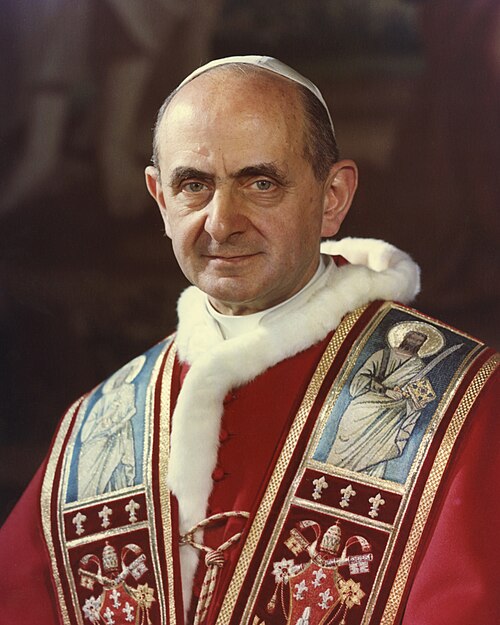
Pope Paul VI in papal vestments.
Fotografia Felici · Public domain · Wikimedia Commons
Appears on: World map: papal visits
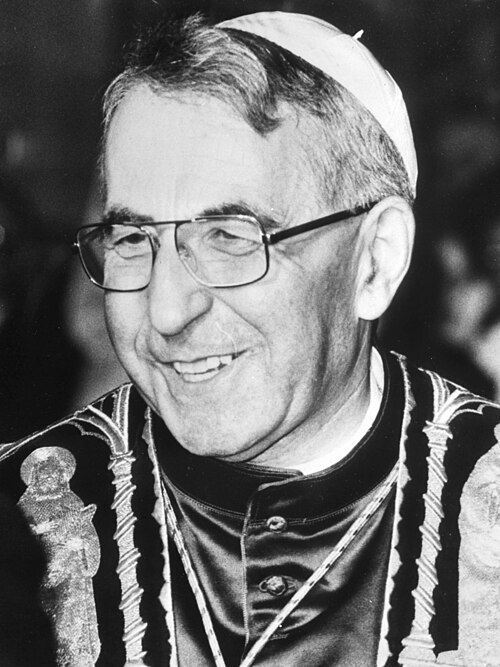
Pope John Paul I in papal vestments.
Anefo / Nationaal Archief · CC0 · Wikimedia Commons
Appears on: World map: papal visits
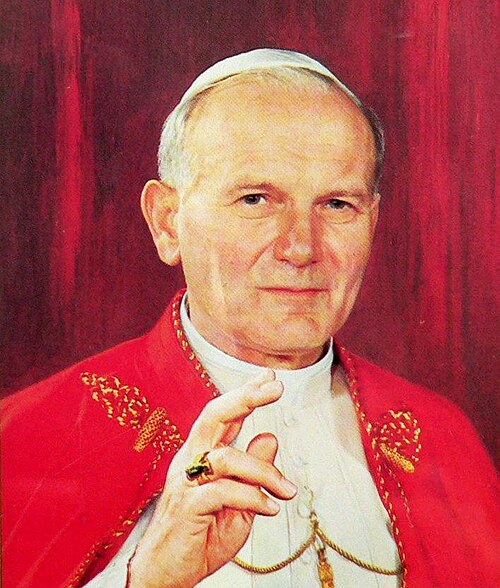
Pope John Paul II in papal vestments.
Beyond Forgetting · CC BY 2.0 · Wikimedia Commons
Appears on: World map: papal visits
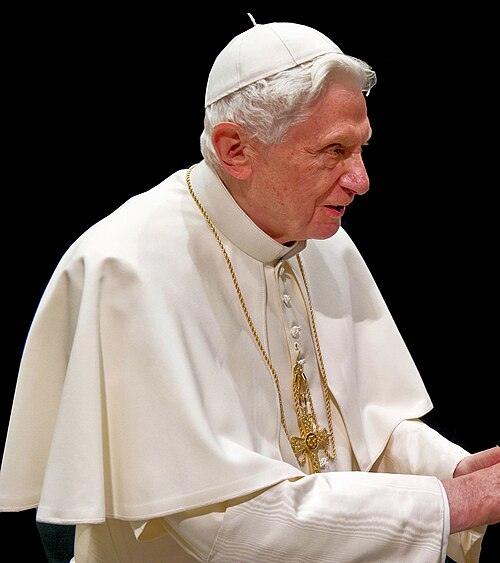
Pope Benedict XVI at a general audience.
U.S. Department of Defense; cropped by Starus · Public domain · Wikimedia Commons
Appears on: World map: papal visits
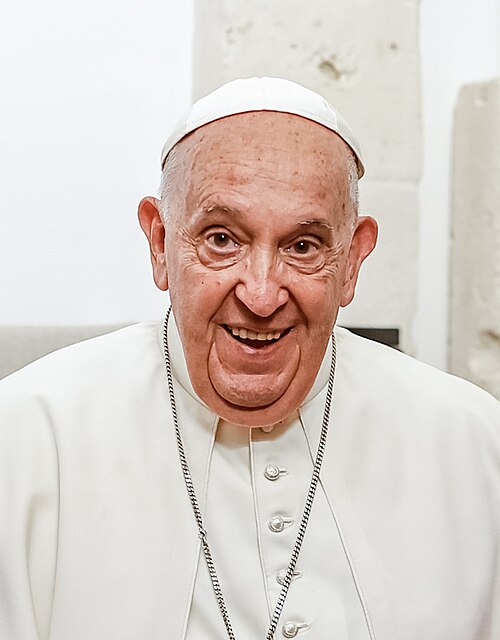
Pope Francis in June 2024.
Ricardo Stuckert / Presidência da República; Lula Oficial · CC BY-SA 2.0 · Wikimedia Commons
Appears on: World map: papal visits
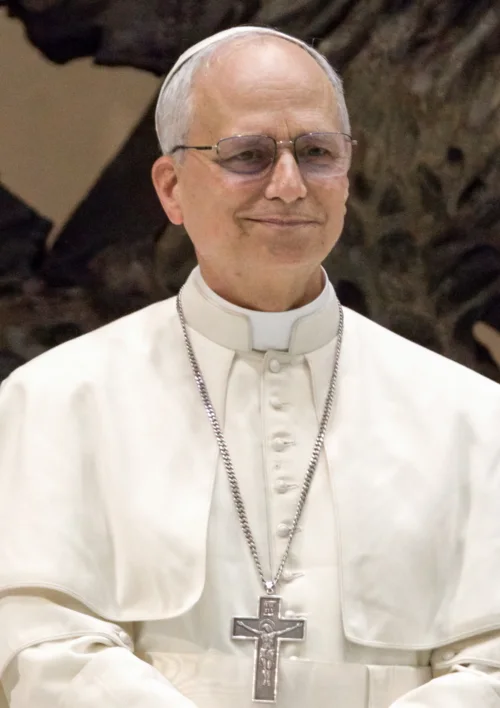
Pope Leo XIV during an audience with the media in May 2025.
Edgar Beltrán / The Pillar · CC BY-SA 4.0 · Wikimedia Commons
Appears on: World map: papal visits

Avignon on the Rhône today. Behind the old Pont Saint-Bénézet rise the cathedral and the fortress-palace the popes built here in the 1300s.
Gzen92 · CC BY-SA 4.0 · Wikimedia Commons
Appears on: The popes live at Avignon

Lake İznik from the town that was once Nicaea. The ruins of an early basilica, where the Creed was prayed together in 2025, lie partly under its water.
Semihekin · CC BY-SA 4.0 · Wikimedia Commons
Appears on: The Creed prayed again at Nicaea

Patrick, holding a shamrock. Icon in Christ the Saviour Orthodox Church, Chicago.
Fr Ted Bobosh (bobosh_t on Flickr) · CC BY-SA 2.0 · Wikimedia Commons
Appears on: Patrick

John Vianney. Marble statue by Émilien Cabuchet, 1867, in the church at Ars.
Andreas König · CC BY-SA 3.0 · Wikimedia Commons
Appears on: John Vianney

Carlo Acutis in his tomb at Santa Maria Maggiore, Assisi, dressed as he lived, in jeans and trainers. His face is a silicone likeness: the Bishop of Assisi said in 2020 that the body was not found incorrupt. Photographed in 2022.
Dulceridentem · CC BY-SA 4.0 · Wikimedia Commons
Appears on: Carlo Acutis
Footage
Clips from Wikimedia Commons, cut into frames that the scroll plays behind the ages of the River's immersive view. The frames carry the clip's licence.
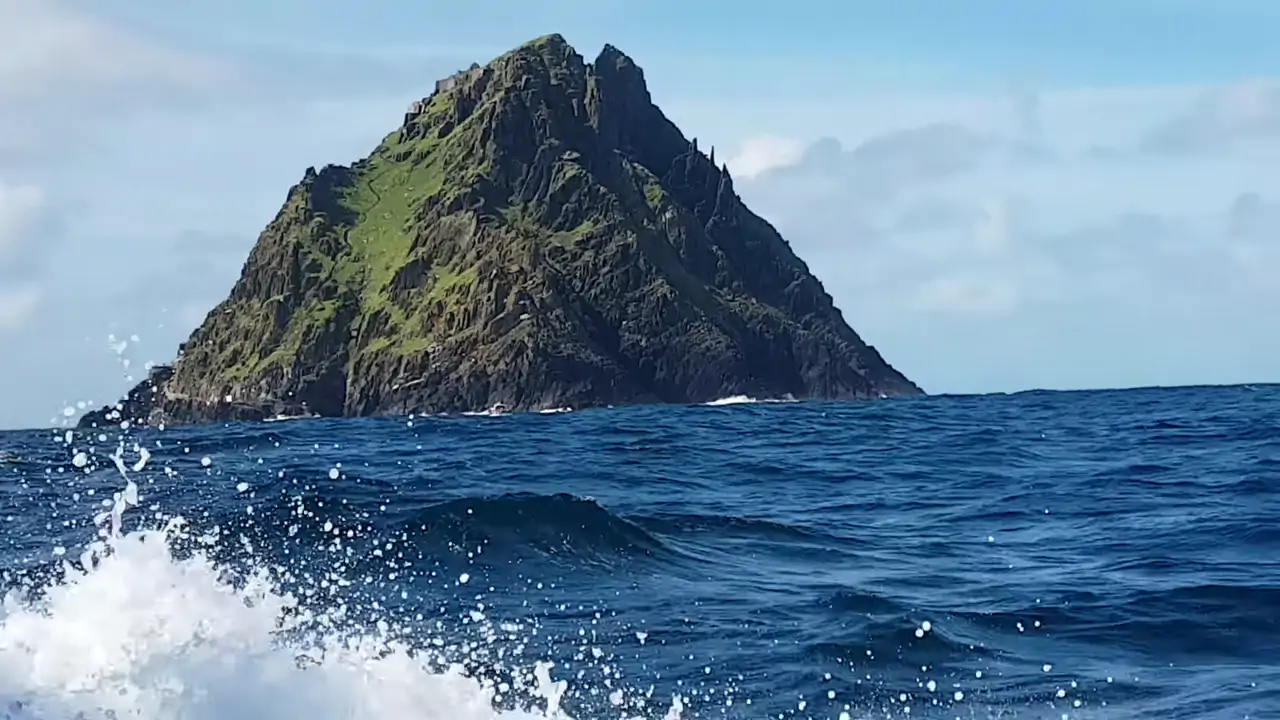
Approaching Skellig Michael, off the coast of Co. Kerry, Ireland, where an early medieval monastery stands
Stinglehammer · CC BY-SA 3.0 · Wikimedia Commons
Appears on: The River, immersive view
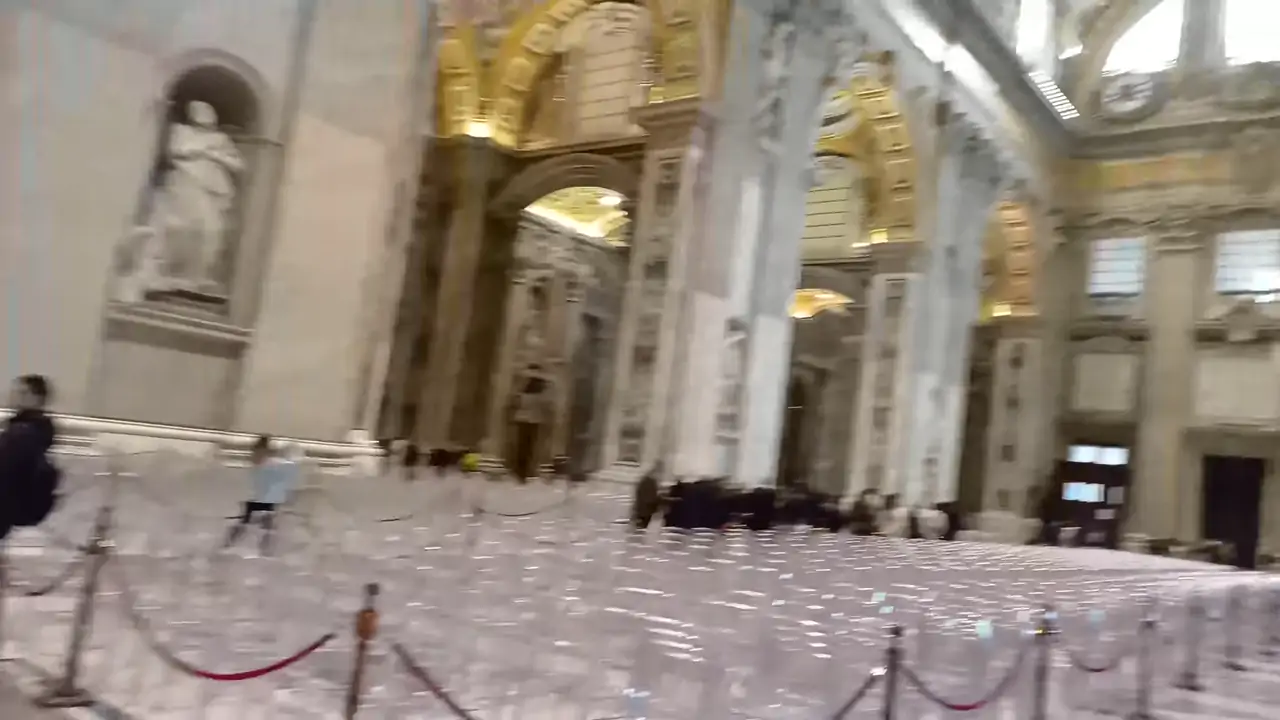
The nave of Saint Peter's Basilica, Rome
Quahadi · CC BY 4.0 · Wikimedia Commons
Appears on: The River, immersive view
Church photos on the map
Fetched live, so they cannot be listed ahead of time.
When you open a church on the world map, its picture comes straight from Wikidata and Wikimedia Commons. Click the picture to open its Commons page, which names who took it and the licence it is shared under.
Music
The River's music. Each is named in the player while it plays, and here.
- ’laxin · Kuromaru and .hereafter · CC BY 3.0 · Wikimedia Commons · The River
- Aesthetic · DreamHeaven · CC BY 4.0 · Wikimedia Commons · The River
- Rainy Winter Day · Happiest Boy · CC BY-SA 4.0 · Wikimedia Commons · The River
- Perspective · Sappheiros · CC BY 3.0 · Wikimedia Commons · The River
